
Hydrotherapy Ayodhya and hydrotherapy treatment Kanpur use warm water, buoyancy, and controlled resistance to ease joint pain, support post-surgical recovery, and help patients rebuild mobility at a pace their bodies can actually handle. Sessions run 20–40 minutes and are led by trained physiotherapists who adjust everything based on where each patient is in their recovery.
Water has been used therapeutically for centuries, but access has always been the sticking point. For patients in Uttar Pradesh, traveling to a metro city just to access a therapy pool wasn’t realistic. That’s starting to change. Clinics offering hydrotherapy Ayodhya and hydrotherapy treatment Kanpur are bringing structured, evidence-backed aquatic rehabilitation closer to home—and the clinical results are worth paying attention to.
Here’s what patients and practitioners in the region should know about how these programs work, who they’re right for, and what a real course of treatment looks like.
What Is Hydrotherapy Ayodhya All About?
Hydrotherapy Ayodhya refers to water-based physiotherapy delivered in clinics and rehabilitation centers across the city. Patients work in heated pools, whirlpool tanks, or dedicated therapy units—moving through guided exercises under direct physiotherapist supervision.
The core mechanical advantage is buoyancy. When a patient is submerged to chest depth, they’re carrying roughly 25–30% of their body weight. That single fact changes what’s possible in early recovery. Add warm water at 33–36°C, and muscle guarding drops before the first exercise even begins. Patients who genuinely can’t tolerate land-based movement can start active rehabilitation much earlier than a standard gym program would allow.
Why Is Hydrotherapy Ayodhya Uttar Pradesh Seeing Growing Demand?
Hydrotherapy Ayodhya Uttar Pradesh has gained real traction over the past few years, and it’s not hard to see why when you look at who’s actually seeking treatment:
- India’s population over 60 is projected to reach 340 million by 2050. Ayodhya’s patient base reflects that aging curve, with more older residents looking for low-impact options to manage arthritis and joint degeneration.
- Orthopedic surgeons are routinely including hydrotherapy in post-operative rehab protocols for knee and hip replacements—particularly during the first four to six weeks when full weight-bearing isn’t yet appropriate.
- Recreational sports participation has risen steadily, bringing with it a predictable uptick in soft tissue injuries where water-based loading allows continued strength work without stressing healing tissue.
- Patients are doing their own research. Non-pharmacological pain management has seen growing search interest across Uttar Pradesh year on year, and hydrotherapy keeps coming up as a preferred option.
Clinics across Ayodhya have responded by investing in dedicated therapy pools and hiring physiotherapists with specific aquatic rehabilitation training.
What Are the Benefits of Hydrotherapy?
The benefits aren’t subtle once you see them in a clinical context:
- Reduced joint load. Chest-deep immersion cuts effective body weight by up to 75%, allowing movement that would be painful or impossible on land.
- Better circulation. Warm water triggers peripheral vasodilation within minutes, increasing blood flow to damaged tissue—something particularly relevant for post-surgical patients and anyone managing soft tissue injury.
- Patients with chronic low back pain typically report meaningful pain reduction within four to six sessions, based on outcomes data from comparable aquatic physiotherapy programs.
- Progressive resistance without equipment dependency. Water resistance scales naturally with movement speed. Push faster, get more resistance. That self-regulating quality works well when you have patients at very different strength levels in the same session.
- Balance training in water carries a much lower fall risk than gym-based programs—which matters significantly for older adults and stroke patients relearning weight transfer.
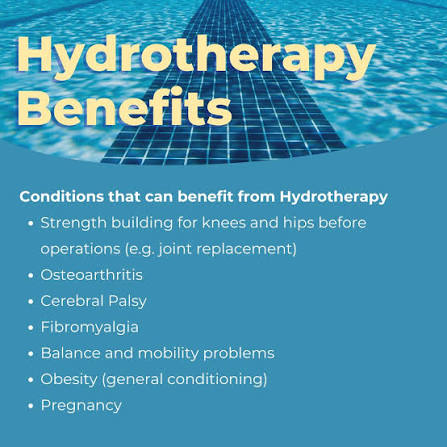
What Conditions Can Hydrotherapy Treat?
Hydrotherapy is clinically appropriate across a wider range of diagnoses than most patients realize:
- Osteoarthritis and rheumatoid arthritis
- Recovery from knee replacement, hip replacement, or lumbar spinal surgery
- Chronic low back pain, especially where land-based exercise has stopped producing progress
- Soft tissue sports injuries—Grade I and II ligament sprains, rotator cuff tendinopathy
- Stroke rehabilitation, where partial unloading allows patients to practice gait patterns before they’re safe to do so on dry land
- Multiple sclerosis, where cooler water variants help manage heat-triggered symptom flares
- Fibromyalgia, where gentle resistance work reduces widespread musculoskeletal pain without triggering post-exertional fatigue
Patient suitability should always be confirmed by a physiotherapist before starting. Open wounds, active skin infections, and uncontrolled cardiovascular conditions are standard contraindications.
What Should You Expect During a Hydrotherapy Session?
Before anyone gets in the pool, there’s a proper clinical assessment. Medical history, current functional limitations, and treatment goals are all reviewed—not to tick a box, but because that information directly shapes the program.
Pool temperature sits between 33–36°C. Warm enough to relax muscles, cool enough that patients can sustain 30–40 minutes of productive movement without fatigue setting in early. A physiotherapist is in the water or poolside guiding the session throughout—this isn’t a supervised swim; it’s a structured therapeutic program.
Exercises vary depending on the condition. Gait training in chest-deep water, resistance work with foam dumbbells, joint mobilization sequences—the specifics depend on where the patient is in recovery and what the clinical goals are for that week.
Most treatment plans run three sessions per week over four to eight weeks, with objective reassessment built in. A patient recovering from total knee replacement, for example, will often transition to land-based physiotherapy once they reach roughly 90 degrees of knee flexion and can tolerate partial weight-bearing without assistance.
What Services and Facilities Are Available for Hydrotherapy Treatment Kanpur?
Hydrotherapy treatment Kanpur has grown alongside the city’s expanding private healthcare sector. Dedicated aquatic therapy units now sit within larger physiotherapy and rehabilitation clinics, which makes coordination with other treatment modalities much more practical.
Facilities offering hydrotherapy treatment Kanpur typically provide:
- Heated therapy pools maintained at clinical temperatures year-round, with hydraulic lifts for patients who can’t manage pool entry independently
- One-on-one sessions with physiotherapists trained specifically in aquatic rehabilitation—not general fitness staff
- Formal treatment planning based on diagnostic imaging and functional assessments, with regular review points built in
- Combination programs that sequence hydrotherapy alongside manual therapy or land-based exercise, depending on where the patient sits in their recovery arc
Who Can Benefit From Hydrotherapy Kanpur?
Hydrotherapy Kanpur serves a broad mix of patients, though the clinical reasoning differs by group:
- Post-surgical patients — particularly those four to six weeks out from joint replacement, when weight-bearing tolerance is still building and land-based loading is too much too soon
- Athletes with soft tissue injuries who need to maintain fitness and load injured structures progressively without risking re-injury
- Older adults with significant balance impairment or osteoarthritis, where fall risk makes gym-based programs genuinely unsuitable rather than just inconvenient
- Patients with fibromyalgia or chronic widespread pain who’ve had poor responses to conventional exercise approaches
- Stroke survivors at the sub-acute stage, using water’s support to practice weight transfer and stepping before dry-ground ambulation is safe
Hydrotherapy Kanpur fits best when recovery demands controlled loading and close supervision—not when a patient is already ready for full progressive gym work.
Taking the Next Step Toward Recovery
Water-based rehabilitation has a well-documented clinical track record. Patients across Ayodhya and Kanpur now have genuine access to that evidence base without needing to travel to Delhi or Mumbai for a specialist facility. Whether the starting point is a recent surgery, a long-standing joint condition, or a soft tissue injury that hasn’t responded to rest alone, hydrotherapy offers a structured path forward that meets patients where they actually are physically—not where a standard program assumes they should be.
For patients in the Lucknow area looking to extend or complement aquatic rehabilitation with a fully structured recovery plan, Physiotherapy Rehab Lucknow offers comprehensive rehabilitation services that connect water-based treatment phases with land-based progression, ensuring continuity across the full course of recovery.